There is a particular week in the Petite Camargue, usually the first proper week of September, when the year seems to exhale. The families who came in July and August have packed the car and driven north. The cicadas are quieter. And the heat, which in August can sit over the flat land like a weight, has lifted into something you can actually live in. Days climb to the mid-twenties, sometimes a touch higher. Mornings start cool enough for coffee outside without squinting. This is the Camargue that people who know the region keep to themselves.
If your school run starts late, or there is no school run at all, September is the month to have this landscape more or less to yourself.
The weather does the work for you
August here is beautiful, but it asks something of you. You plan around the middle of the day. You keep the shutters closed until evening. September asks less. Daytime highs settle around 25 to 28°C in the first half of the month, easing gently as the weeks pass, and the nights drop back to the mid-teens, which is exactly what you want for sleeping with the windows open. There is more give in the day. You can walk the salt-crusted lanes at Aigues-Mortes at two in the afternoon and not regret it.
The pool at the house holds its heat well into the month, and the Mediterranean, twenty-five minutes down the road, is still sitting at around 21 or 22°C. That is the trick the sea plays in this part of France. It spends all summer warming up and only reaches its friendliest just as everyone assumes the season is over. The beaches at Le Grau-du-Roi and La Grande-Motte, shoulder to shoulder in August, empty out. You can swim in September and feel like the water was left running for you.
The mosquitoes, which are a fact of Camargue life and worth being honest about, also ease off as the standing water recedes. They do not vanish, but the evenings outside are markedly kinder than high summer.
The two big ferias: rice, then wine
September is when the region gathers itself to mark the end of the growing year, and it does so twice, in two of the finest surviving Roman cities in France. Arles and Nîmes are living vestiges of the Empire: their great amphitheatres still stand at the centre of each town, nearly two thousand years on, but they are only the most commanding part of what Rome left. Arles keeps its theatre, its baths and the underground cryptoporticus; Nîmes has the Maison Carrée, one of the best-preserved Roman temples anywhere, and the Tour Magne above the city. That both cities still fill these arenas for their September ferias, less than an hour from the house, is part of the pleasure.
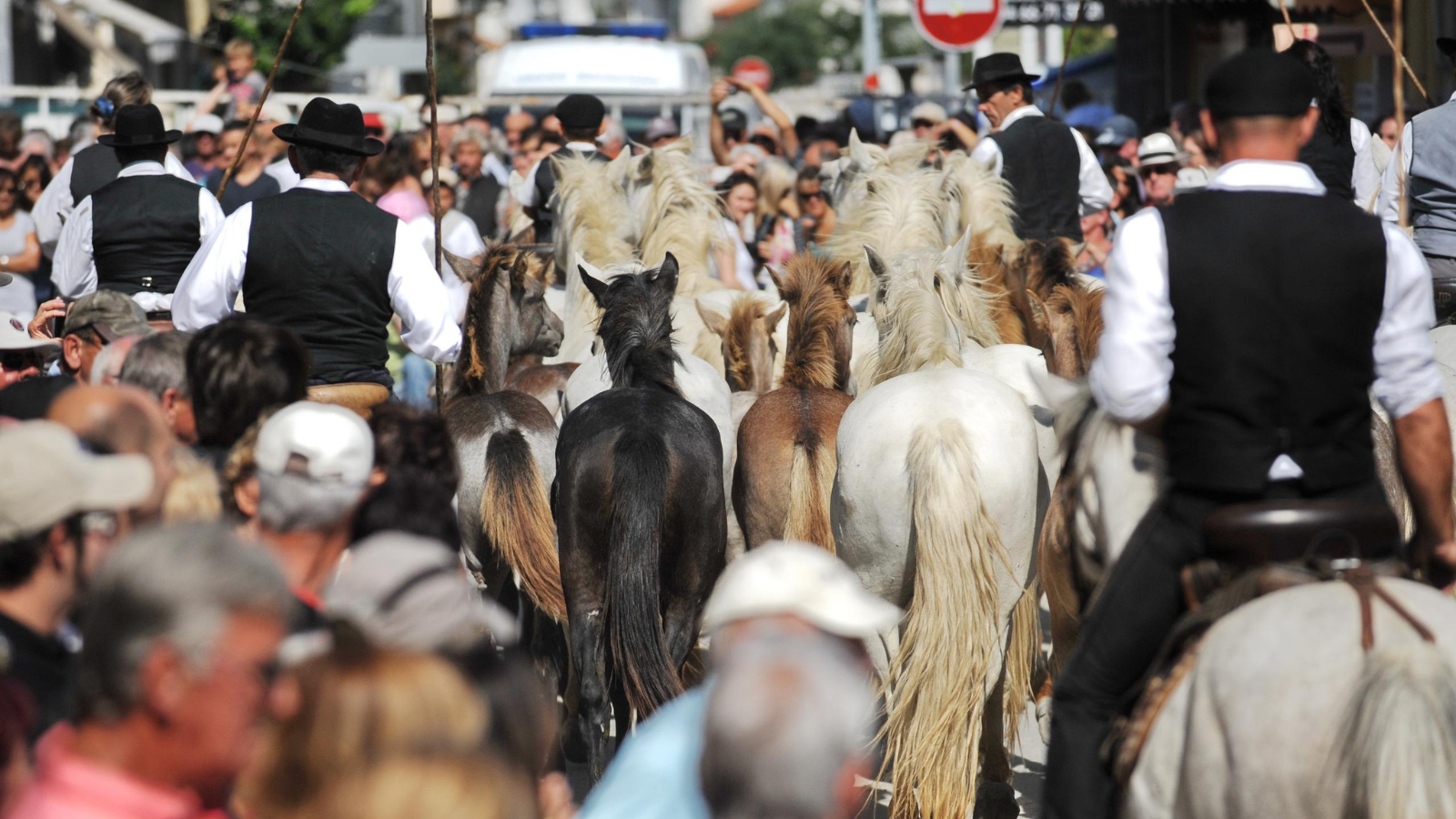
First comes the Feria du Riz in Arles, which in 2026 falls over the weekend of the 11th to the 13th. Its name means the rice feria, and that is not decoration. The Camargue is one of the few places in France where rice is grown, out in the flooded paddies of the delta, and the harvest is in full swing through September. The feria marks it. For three days Arles turns itself over to the festivities: courses camarguaises in the old arena, abrivados through the streets as gardians on horseback drive the bulls between barriers, and bodegas spilling music and paella and glasses of rosé into the evening. It is the smaller, more local cousin of the famous Whitsun feria, and many people prefer it for exactly that reason.
A week later, Nîmes takes its turn. The Feria des Vendanges runs across the third weekend, the 18th to the 20th in 2026, and it does for the grape harvest what Arles does for the rice. The vendanges are underway across the Costières de Nîmes vineyards that ring the city, the most southerly appellation of the Rhône, shaped by the same mistral and sea breezes that cross the Camargue. Nîmes celebrates in the same idiom as Arles: bulls, horses, bodegas, and casitas along the boulevards serving gardianne de taureau and the region's own wines. Families go. It is the kind of evening you stumble into on a Saturday and remember for years.
Both ferias include corridas in their arena programmes, the Spanish-style bullfighting that draws large crowds and remains, as it does everywhere, a matter people feel strongly about on both sides. If that is not for you, here is the reassuring part: you can skip the arena entirely and still get the whole feria. The heart of these weekends is in the streets, not the ring. The bodegas, the bandas moving from square to square, the casitas and their long tables of food, the courses camarguaises where the bull is never harmed and the sport is in the raseteurs darting past it, the sheer sight of two ancient cities coming to life after dark. All of that is free, and all of it is the point. Follow the sound of the brass, find a table, order a glass of something local, and let the evening carry you. The arena programmes are published closer to the dates by the arenas themselves, for those who want them.

Gentler traditions, closer to home
Not every September celebration comes with a bull ring, and two of the loveliest sit right on the doorstep.
On Saturday 5 September, the little seaside town of Saintes-Maries-de-la-Mer holds its Fête de la Saladelle. The saladelle is the modest violet flower that carpets the salt marshes through late summer, one of the emblems of the Camargue alongside the flamingo and the white horse, and the town celebrates it with a défilé à l'ancienne: old-fashioned horse-drawn carts, a transhumance of sheep brought through the streets, Arlésiennes in traditional dress, folklore groups, and an afternoon show in the arena with horseback displays and a gentle abrivado. The street events are free, the arena show is a few euros, and the whole thing has the feel of a village turning out for itself rather than for visitors. It is about as warm and unthreatening an introduction to Camargue tradition as you could ask for.
Then there is Le Grau-du-Roi, the working fishing port a short drive south, which in 2026 celebrates the eightieth year of its fête votive. Running since 1946, it fills the better part of two weeks in September with abrivados, bandidos, courses camarguaises, bals, and something you will not see inland: joutes languedociennes, the old Languedoc water-jousting where two competitors on raised platforms are rowed towards each other and try to knock their opposite into the canal. It is the town's own blend of terre et mer, land tradition and sea tradition, and for an eightieth-anniversary edition it will be worth timing a visit around. Exact 2026 dates shift year to year, so check with the Grau-du-Roi tourist office before you go, but the port is a fine place to spend an afternoon regardless, and easily folded into a trip to the beach.
The quiet the birds prefer
The flamingos do not leave. They are in the Camargue all year, and while their numbers peak in spring when tens of thousands gather to breed, September still brings good, close viewing at the Parc Ornithologique de Pont de Gau, where the paths wind through the marsh and the birds stand in the shallows a few metres from you. What changes in September is the company. The summer crowds have gone, and so have most of the other birdwatchers, which leaves the reserve calmer and the light softer. Autumn migration is beginning, so the marsh fills with waders and ducks moving through on their way south.
Out in the fields, the rice harvest gives September its working backdrop. Rice has been grown here since the Rhône was embanked in the 1850s, and today around two hundred Camargue growers bring in something close to a third of all the rice France eats, the crop protected since 2013 by its own IGP. The red variety is the one to look for: a nutty, whole-grain rice that turns up on every good local menu and in the paella at every feria. Through September the paddies that have sat under a sheet of water all summer are drained and cut, and the machines move slowly across the delta bringing it in. The white horses and the black bulls are where they always are, out on the manades, and a morning visit to a working ranch is easier to arrange now that the peak-season rush has passed. This is the landscape the region is named for, and September strips away the crowds that can stand between you and it.
A week at the house, September pace
What makes September at La Maison d'à Coté is not any single outing. It is the rhythm. There is no rush to beat the heat, no queue for anything, no need to book dinner a week ahead. Days can be as full or as empty as you want them.
Mornings are for the markets. Aimargues holds a Sunday producers' market a couple of minutes from the house, and the wider week gives you the pick of the Petite Camargue's village markets, tables of tomatoes still warm from the field, olives, honey, goat's cheese, and the last of the summer melons. Fill a basket, and half your holiday catering is done. The house has the kitchen and the long table for it, and the garden holds the day's warmth for a late lunch outside.
Afternoons stretch. With the heat off the boil, the flat lanes between the vines and the rice fields are made for cycling, gentle, shaded in places, and almost traffic-free once the summer visitors have gone. Aigues-Mortes is a short drive: you can walk the full circuit of its medieval ramparts in September without the July sun bearing down, then drop into the Salins du Midi next door, where the salt is piled in blinding white mounds beside water turned pink by the same micro-organisms that colour the flamingos. It is one of the strangest and most photogenic sights in the region, and it stays open through the season.
And when you have had your fill of doing things, the house makes doing nothing easy. The pool is warm. The evenings are long enough for a slow dinner and cool enough to want a light layer by the end of it. Pour a glass of the local vin des sables, the pale, faintly saline gris grown on the coastal dunes just south of here, and watch the light go. There is time to do very little, which in September is rather the point.
Getting the balance right
The one honest caveat: September is shoulder season because the weather, while lovely, is a shade less certain than midsummer. You might catch a day of rain. The mistral can still blow through, though Aimargues sits in a gentler pocket than the open plain to the east and generally escapes the worst of it. Pack a light jumper for the evenings and you will not be caught out.
In return you get quiet roads and warm water. You get two great ferias and two gentler fêtes inside a fortnight. You get restaurant tables without a fortnight's notice, markets at their late-summer best, and a landscape that feels, for a few weeks, almost private. For couples, for friends travelling without children, for anyone whose calendar is not ruled by the school gate, this is the window. The Petite Camargue in September gives you everything the summer does, at a pace the summer never allows.
Still available — September 2026
Have the Petite Camargue to yourselves
La Maison d'à Coté sleeps up to 11 and takes weekly stays right through September. Warm days, quiet beaches, and the harvest ferias on your doorstep.
View availability →