There's a sound that means summer has properly arrived in this part of France. It isn't the cicadas, though they help. It's the soft glug of water hitting pastis in a tall glass, the clink of two ice cubes going in after, and the gold liquid turning the colour of clouded honey while someone you've known for an hour tells you exactly which brand you should have ordered instead.
That last part matters more than you'd think. We'll get to it.
Pastis is the drink of the apéro, the slow hour before dinner when nobody is in a hurry and the whole point is to sit down. In the South it's so woven into daily life that people barely call it by its name. In Marseille and across Provence it's le petit jaune, the little yellow one. You don't drink a pastis on a hot afternoon so much as you submit to one.
A drink born from a ban
The strange thing about pastis is that it's younger than it tastes. It feels ancient, like something the Romans would have sipped, but the drink you'll pour at the house didn't exist in any commercial form until the 1930s.
To understand why, you have to start with absinthe. Through the late nineteenth century the green spirit was everywhere in France, helped along by a disaster: the phylloxera louse had wrecked huge stretches of the country's vineyards, wine grew scarce and expensive, and people turned to the cheap, potent stuff instead. Absinthe got the blame for all manner of social ills, fairly or not, and in 1915 France banned it outright, along with most high-strength anise drinks.
The South, where aniseed was practically a food group, was not pleased. Bartenders and home distillers started quietly mixing their own anise concoctions to fill the gap, using green anise, star anise, fennel and liquorice. The word they reached for was pastis, from the Provençal pastisson, meaning a mixture or a mash-up. There's a lovely accident of language here: to this day, one way of saying "I'm in a mess" in French is je suis dans le pastis. Make of that what you will after your third glass.
Through the 1920s the government, eyeing the tax revenue it was missing, began to relent. Milder aniseed drinks were allowed back provided they kept the alcohol down and left out the wormwood that had made absinthe so notorious. That crack in the door was all one young man from Marseille needed.
The man who put his name on the bottle
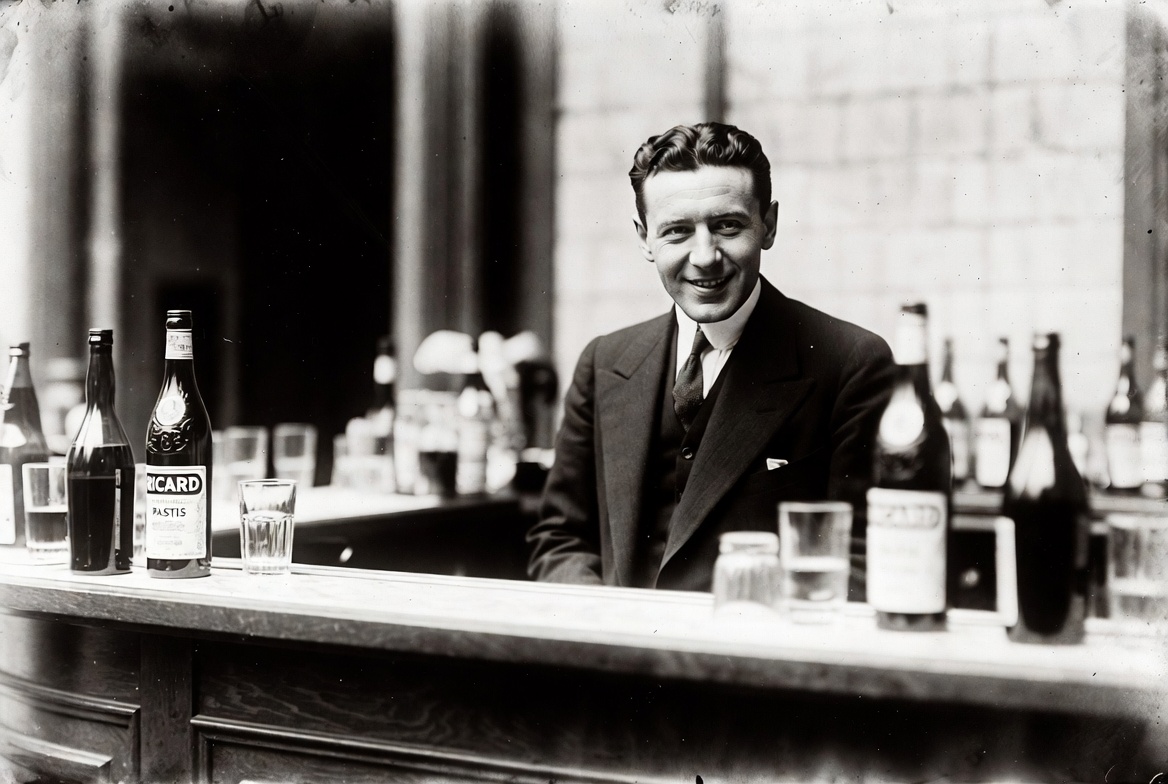
Paul Ricard was the son of a wine merchant, born in 1909 in the northern edge of Marseille. He'd been experimenting with anise recipes in a still in his bedroom, blending star anise, fennel seed, liquorice and the wild herbs of the garrigue, the scrubby thyme-and-rosemary hillsides above the city. By 1932 he was ready, and the law had shifted just enough to let him sell.
What set Ricard apart wasn't only the recipe, which he kept secret and which his company guards to this day. It was the nerve of his marketing. He called his drink "the true pastis of Marseille," went door to door to the bistros and cafés telling them the story of herbs hand-gathered from the Provençal hills, and made the whole thing feel like a piece of the South you could pour. It worked almost absurdly well. By 1938 he was selling 2.4 million litres a year and had overtaken the older, grander houses.
The rivalry that defines pastis was waiting on the other side of the war. Pernod, a name already famous from its absinthe days, launched its own anise aperitif in 1951 and called it Pastis 51 after the year. For two decades Ricard and 51 were archrivals, each with its own loyalists, each insisting it was the real thing. Then in 1975 the two houses shook hands and merged into Pernod Ricard, which went on to become one of the largest drinks companies on earth. The rivalry, charmingly, never died with the merger. People still take sides. They take sides hard.
Why the cloud happens
Watch a pastis turn from clear gold to milky yellow and you're watching a small piece of chemistry that the French have turned into theatre. The effect is called the louche, and it's the sign you've made the drink properly.
Pastis gets its flavour from anethole, the essential oil in anise. Anethole dissolves happily in alcohol but not in water. In the bottle, at around 45% alcohol, it stays invisible and the liquid is clear. The moment you add water the alcohol level drops, the anethole can no longer hold itself in solution, and it breaks into millions of microscopic droplets that scatter the light. That's the cloud. Pour slowly and you can watch it bloom up through the glass.
It's the same phenomenon that clouds ouzo and absinthe, and it isn't only for show. Releasing those oils is what softens the bite and opens up the aroma. A pastis drunk neat is a harsh, punishing thing. A pastis properly loosened with cold water is one of the great long drinks of summer.
How to pour it without embarrassing yourself
Here's where a little knowledge saves you. The ritual is simple, but the order of operations is not optional, and getting it wrong in front of a southerner is a minor social event.
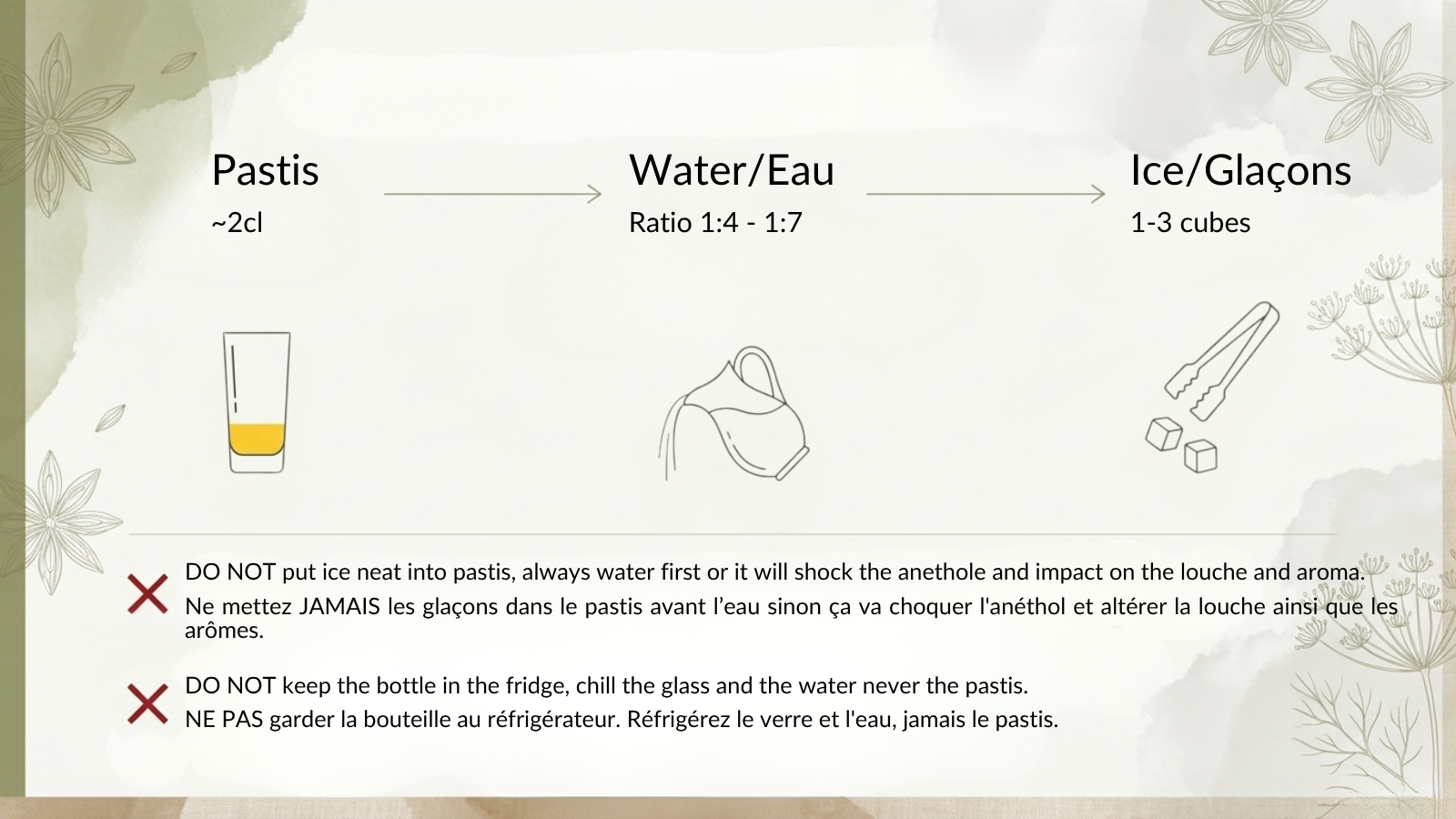
Start with the pastis, a small measure, around 2cl, in a tall straight glass. Then add cold still water, and here's the number that matters: roughly five parts water to one part pastis. Some go lighter, four to one; on a scorching day plenty of people push it to seven to one. Pour the water in slowly and watch the louche develop.
The ice goes in last. This is the rule people break and regret. If you drop ice straight onto neat pastis, the sudden cold shocks the anethole, it seizes and crystallises, and you lose both the clean louche and some of the aroma. Water first, ice after. One or two cubes, no more. And don't keep the bottle in the fridge for the same reason: chill the glass and the water, not the spirit.
One more thing the locals are firm about: pastis is an apéritif, full stop. It opens the meal, it doesn't close it. Drink it before you eat. Suggesting it as a digestif after dinner will earn you the same gentle horror as putting the ice in first.
If you want to play, the South has a whole rainbow of variations, mostly made by adding a splash of syrup. A mauresque takes almond orgeat and turns milky white. A tomate gets grenadine and a red blush at the bottom of the glass. A perroquet, "parrot," goes bright green with mint syrup. A rourou turns pink with strawberry. There are dozens more with names that make no sense and need none. Children, meanwhile, drink the syrups straight, mixed only with water, while the grown-ups have theirs with the petit jaune underneath.
What to put on the table beside it
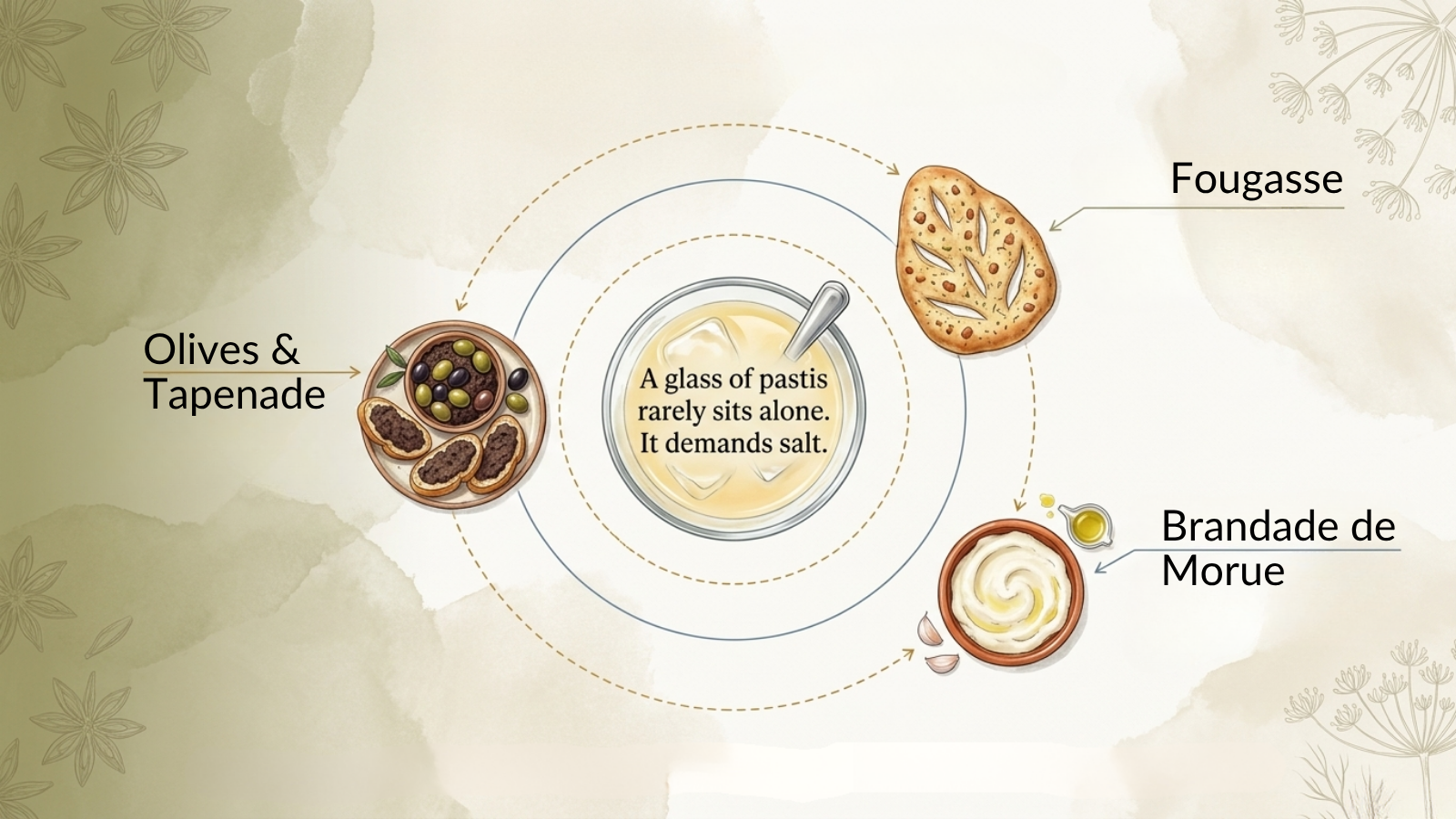
A glass of pastis rarely sits alone. It wants something salty alongside, and the Gard happens to be generous on that front. The simplest move is a bowl of local olives and a dish of tapenade, the dark olive, caper and anchovy paste you spread on toasted tartines of baguette. Then there's fougasse, the flat Provençal bread that comes studded with olives or, in the Gard version, with crisp little grattons. Tear it, pass it round, and it disappears faster than you'd plan for.
If you want to set down something that belongs entirely to this corner of France, reach for brandade de morue. This is the dish of Nîmes, a smooth purée of salt cod whipped with olive oil, milk and a little garlic, born centuries ago from the old trade that swapped Camargue salt for dried cod. Spread it warm on a grilled tartine and you have the most local mouthful imaginable to go with your glass. Salt cod, olives, anise: it all comes from the same sun and the same flat, briny land you can see from the garden.
When you'd rather skip the alcohol
Not everyone at the table wants the real thing, and the South has an answer for that too. Ricard makes a non-alcoholic version called Pacific, launched back in 1982 for the brand's fiftieth anniversary, built around the same anise extracts without the 45%.
Be honest with yourself about what it is. To a committed pastis drinker, Pacific can land a little flat, with a faint bitterness the originals don't carry. But for anyone taking a break from the booze, it's a genuinely good, clean alternative, and it lets them join the apéro instead of nursing a glass of water. One tip from experience: you'll want to roughly double the usual dose to get the deep aniseed-and-liquorice hit people actually crave from a pastis, so pour a little heavier than the standard one-to-five. It also stands in nicely for the coloured cocktails, making a respectable alcohol-free perroquet with mint syrup or tomate with grenadine for whoever's driving home.
Which one to order at the house
So, the awkward part. When you're staying at La Maison d'à Coté and you wander into a village bar in the Petite Camargue, or stock the kitchen for an evening on the terrace, which pastis do you actually buy?
Here, the answer is simple. Order the 51. You barely have to say the word "pastis" at all; mutter the number and the person behind the bar knows you know. It marks you out as someone who has been here before, or at least had the good sense to ask. The 51 is the lighter, fresher one, a touch less heavy on the liquorice than Ricard, and around our part of the South it's the one that gets poured without a second thought. Stock a bottle in the kitchen and you'll be drinking what your neighbours drink.
Keep that 51 for the everyday apéro on the terrace, the glass you pour when friends arrive and the pétanque is about to start. Then, if you want to go a step further, tuck a bottle of Henri Bardouin behind it for the night you cook something worth lingering over. Made up in Forcalquier from more than sixty-five plants and spices, from local thyme and rosemary to star anise from China and tonka beans from Guiana, it's the connoisseur's pastis, and one of the few many southerners will actually let onto the dinner table rather than strictly before it. If the 51 is the drink of the village square, Henri Bardouin is the one you bring out when you want someone to slow right down and pay attention to what's in the glass.
Buy them in the local supermarket, watch how the person ahead of you in the queue does it, and you'll fit right in by the second evening. Because that's the real point of the petit jaune. It was never about the alcohol. It's about pulling a chair into the shade, pouring something cold and slow, and letting the afternoon take as long as it wants. There are worse traditions to borrow for a week in the South.
Ready to pour your own petit jaune under the shade of our Olive tree?
La Maison d'à Coté sleeps eleven, with a private pool and a shaded terrace made for the long apéro hour. Get in touch to check availability for your stay in the Petite Camargue.