There is a kind of morning here that you come to look forward to. You draw the shutters back and the sky over the garden has gone to a blue so clear it looks rinsed, no haze anywhere, the far hills sharp enough to pick out one by one. The air is dry and bright. It will be a good day, the sort this coast is quietly famous for, and the reason is the wind. Not a storm, not a nuisance, just a steady northern air that has swept the sky clean overnight and left the whole delta looking scrubbed and new.
This is a piece about that wind, or rather about two of them, because the honest story of our weather is a story of two masters. To the east lies the country of the mistral. To the west, the country of the tramontane. Aimargues sits close to the line where one hands over to the other, and living on that line is what gives the Petite Camargue its particular light. I want to tell you about both winds, where they come from, what the old Provençal speakers called them, and why, between the two, they make more good days here than bad ones.
The master and its western cousin
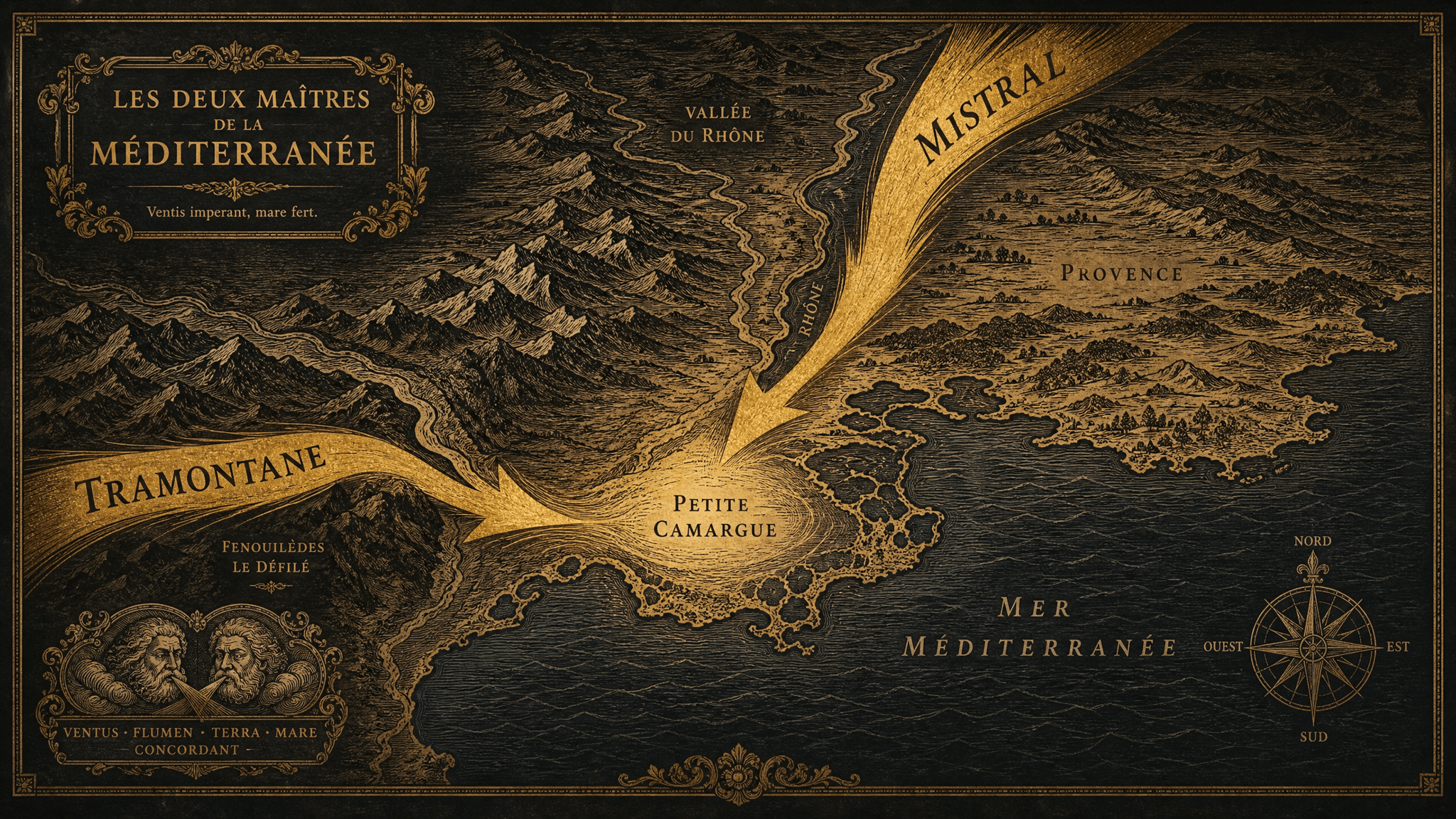
Both winds are, in their way, the same idea arriving from two different doors. Cold, dry air spills down off the north, gets squeezed between mountain ranges, picks up speed in the squeeze, and pours out toward the Mediterranean under a hard blue sky. The difference is which corridor it takes.
The mistral comes down the Rhône valley, funnelled between the Alps and the Massif Central, and fans out over Provence and the eastern edge of the Camargue. Its name says everything about how people regarded it. Mistral traces back through the old Provençal maestral to the Latin magister, the master. This is the master wind, the vent-maître, and the title was earned. The tramontane takes the other corridor, threading between the Massif Central and the Pyrenees, and it rules the skies of the Languedoc to our west, out toward Perpignan and the Aude. Its name comes from the Latin trasmontanus, the wind from beyond the mountains. Two winds, two valleys, one shared talent for wiping a sky clean in a couple of hours.
Sit with a local long enough and you learn that a wind with real character collects nicknames. The mistral gathered a whole set. When it lifts a hat clean off your head it is the rauba-capèu, the hat-thief. When it dries the winter mud to dust it is the manjo-fango, the mud-eater. When it sweeps the lanes it is the escoubaïre, the sweeper. A soft, kindly version earns the fond little name mistralet; a hard one gets called a mistralas and spat out like a complaint. You do not give a wind that many names unless you have spent generations living alongside it, the way you might a relative who is difficult but unmistakably yours.
Living in the overlap
Here is where I want to be plain, because the tourist version tends to stamp the mistral across the whole south and leave it there. The truth around Aimargues is more interesting than that, and gentler. We do not sit in the full fury of either wind. We sit in the overlap, the calm seam between them.
The sailors who work the bay of Aigues-Mortes, just down the road from us, describe it well. They talk about the bay as a quieter bubble, a place where you can feel the handover happening, mistral territory on one side, tramontane territory on the other, and our stretch of coast sitting in the softer space between. The Gard is a little to the west of the mistral's heartland and a little to the east of the tramontane's, so what reaches us is usually the fanned-out tail of one or the other. It is often breezy. It is rarely brutal. A true, hard mistral does sometimes push this far west, the kind of day people remember by its date, like the February in 2015 when gusts topped 140 kilometres an hour up at Nîmes, but those are the exceptions that get talked about precisely because they are rare.
Most of the time, the wind here is doing its best work rather than its worst. It is drying the air, holding off the cloud, keeping the mildew off the vines, and delivering that endless run of clear days that made this one of the sunniest corners of France. The fierce reputation belongs mostly further north, up the Rhône where the mistral is squeezed hardest. Down here on the frontier, we tend to get the light without the violence.
What the wind builds
Whatever you decide to call the air on any given day, it is one of the hands that shaped this landscape, and it keeps shaping it. The Camargue is flat, wet, and wide open, so there is nothing to slow the wind once it arrives, and nothing to stop the light either. Stand out on the sansouïre, the salt steppe where only glasswort and sea lavender can grow, and the horizon just lets the air run. Alphonse Daudet felt it when he wrote his Lettres de mon moulin, describing a sense of solitude and space made greater by a wind that blows without pause and without obstacle.
The wind even moves the water. Out on the great lagoons, the étangs, the level and the saltiness rise and fall on a slow see-saw that people here have watched for generations. A northern wind pushes the fresher water of the Vaccarès down into the lower lagoons and thins the salt; when it drops, or when the warm marin blows up from the sea instead, the water swings back and the salt creeps in again. The flamingos, the glasswort, the tiny brine shrimp that tint both the water and the birds pink: all of it lives inside that rhythm of wind and salt. The reeds join in too. The tall canne de Provence grows in living windbreaks along the water, and a hedge of it bending and streaming under a good blow is one of the small pleasures of a walk out here.
The animals read the air better than we ever will. Out in the manades, the herds of black Camargue bulls stand close together when a strong wind sets in, heads lowered, horns turned into it, waiting it out. And the small white Camargue horse, that half-wild creature of the marshes, carries the wind in the phrase people still use for it. A horse made, they say, of mistral, of salt, and of courage. It is hard to say it better than that.
The reputation, and the poet
The winds of the south carry an old reputation for working on the mind, and it would be dishonest to pretend otherwise, though it belongs more to the fierce northern mistral than to our milder frontier air. A long spell of it, the belief runs, brings headaches, short sleep, and shorter tempers. The writers never agreed on it. Nietzsche, who spent restorative time in the region, loved the wind and called it a killer of melancholy, all that scoured blue sky doing his mood good. Colette named it the tormentor. Stendhal simply found it irritating. Same wind, opposite verdicts, which feels about right for something that can hand you the clearest afternoon of your life. Country people, meanwhile, learned to see it coming without any forecast at all. A red sky at dusk meant wind by morning. Cats chasing each other across the yard, sheep turning skittish, even earthworms surfacing clean rather than muddy, all of it was read as the wind's calling card. There was a saying too, still repeated, that the wind blows in threes: three days, or six, or nine.
No account of this wind can leave out Frédéric Mistral, though the tidy story that he was named after it is a myth worth correcting. Mistral was an old family name in Maillane long before the poet was born, sharing the same Provençal root as the wind rather than borrowing from it. What is true, and better, is the world he built with it. He won the Nobel Prize in 1904 for writing in Provençal, a regional tongue the schools of his day were busy trying to erase, and he spent his life rescuing the language and the culture bound up in it. His great poem Mirèio sends its heroine on a doomed journey across this very delta, ending at Saintes-Maries-de-la-Mer down on the Camargue coast. He gave the region its own voice back, wind and salt and open savanna and all. Stand in the garden here on a clear, wind-washed evening and you are standing inside the landscape he spent a lifetime defending.
That, in the end, is why two winds are worth a letter home. It is not the drama, because most days here there isn't much. It is that this clean, dry, luminous air is the thing that makes the Petite Camargue itself: the impossible clarity, the pink and white of the salt flats, the low farmhouses built with their backs to the north, the bulls and the horses, and the poet who saved the words for all of it. You cannot separate the place from the winds that carved it. Come for a week when the sky is running clear and blue, and you will leave understanding the south a little better than the postcards allow.
Experience the light of the Camargue
If that clean, wind-washed light sounds more like a draw than a warning, La Maison d'à Côté sits right here in the calm country between the two winds, with a big enclosed garden, a private pool, and long, bright days to fill. Get in touch to see which weeks are still free.